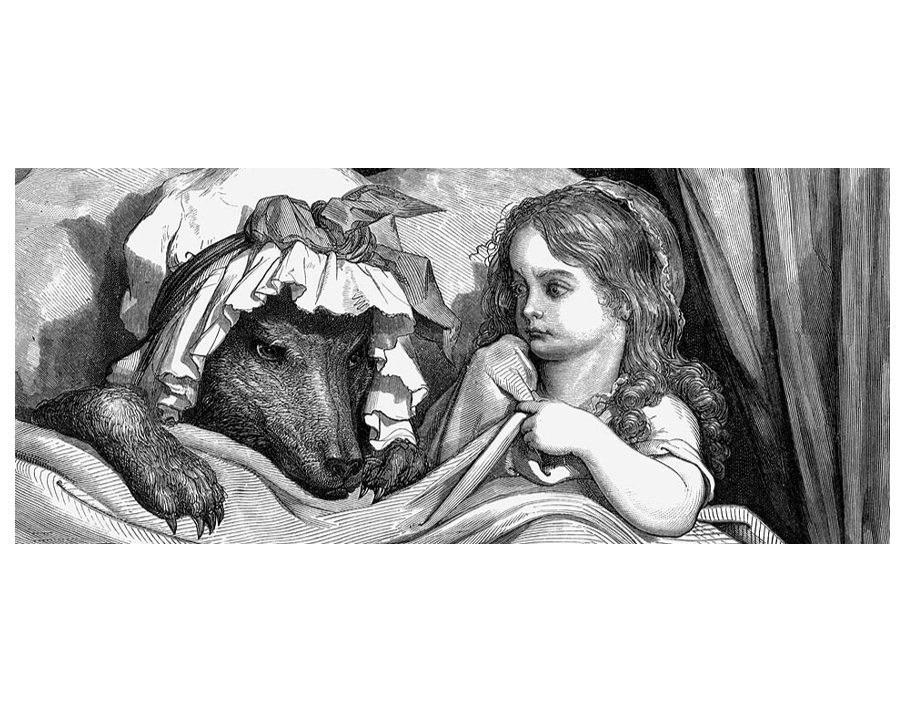
编辑推荐 | 少女与狼
夏尔·佩罗的《小红帽》和安洁拉·卡特的《与狼为伴》中的性与身份认同
米娅·撒玛尔季奇
世界各地的保守派和自由派之间的价值观念差异令纷争长年显著,在事关性与道德的讨论中扮演着至关重要的角色,这使得《小红帽》和《与狼为伴》成为构建分析性观点的优秀文本。
少女与狼的邂逅在夏尔·佩罗的《小红帽》(1697)和安洁拉·卡特的《与狼为伴》(1979)中都象征着女孩的失贞,但两部作品采取的论调迥异:性接触令佩罗的小红帽死去,卡特的小红帽却从性经历中获得满足。对于这种欢愉的不同刻画都对女性的性表达有着深刻的见解。两位作者在各自的故事中细致地处理了女孩-斗篷的身份认同问题、男性-狼的同质化问题,以及野兽-孩子的权力动态问题。佩罗希望《小红帽》成为一则警示,告诫女孩必须压抑自身的性欲,将性视为洪水猛兽。卡特的意见更具女性主义色彩,认为女性不应畏惧此种需求、不应害怕去试着满足性欲,并且鼓励女性要在这方面勇于探索。卡特认为真正的危险来自性压抑,而不是性本身。很明显,在性与性对道德身份认同的影响的议题上,佩罗采保守主义观点,卡特的立场则自由主义得多。
佩罗始终用「小红帽」来指代小女孩,这个名字来自故事之初她收到由祖母缝制的斗篷。斗篷在此处有着重要的喻指:童贞。按佩罗的说法,童贞具备斗篷一般的保护作用,保护的对象则是一种稚气无辜的 纯洁 状态。斗篷在她与狼相遇时脱去,小红帽失去了这种保护她免受罪恶侵扰的性纯洁。故事里的原话是,斗篷「令小红帽如此完美」,她脱掉斗篷的同时其实是抛弃了身份认同的极重要的组分。小女孩与其斗篷同名,是在用后者定义前者,斗篷被抛在一边,她就变得「赤裸」了。这种暴露最终导致她的死,她立即失去对狼的抵御,被囫囵吞食。佩罗给出了一种女性印象,她们在变得成熟的过程中因失去纯洁而崩塌:不仅是通过摧毁其童贞,更是靠动摇她们作为人类本身的正当性。这一潜在信息警告要求女性守护其童真,以求保全构成道德身份认同的纯洁状态和价值。
尽管卡特同样用斗篷指代童贞,可这里童贞远非如佩罗文中设定的那样构建了女孩身份认同的全部。在《与狼为伴》中,小女孩不再唤作「小红帽」,而是被描述为「亚麻色头发的女孩」。这意味着斗篷不再是她成其所是的关键部分,她的身份不单单被她的童贞和纯洁所定义。依照卡特的说法,在她「脱去了那猩红色、罂粟色、那牺牲和月经色的披肩」后,她作为一个人成长,而非走向死亡。罂粟作为时常与死亡联系在一起的意象,在这里象征的是小女孩此前对性的无知走向终点。这种「无知的死亡」在原文中被以「牺牲」指代,是为了更具价值的事去献祭手头上的一些东西。这个 更具价值之物 在卡特的故事里指的是女孩新获的生殖力,初尝禁果的落红象征着她已步入其女性时代。到此,失去童贞不再是一件需要哀悼的事情,而是生命中正常的一步,现在她的身体已在生物学意义上做好了生育的准备。卡特在整体的意义上构建了这样一种与佩罗相左的价值导向,认为只要在生理上已经准备好,年轻女孩完全有权利自己决定是否进行性活动。卡特描绘的女性完全能够掌控自己的性决策,同时掌控其带来的后果。在这里失去童贞不再会贬损女性的价值,而是标志她正在成熟的一个新体验。
狼在两部作品里都象征寻求性活动的男人,但其兽化程度不尽相同。在《小红帽》中,狼和男性被视为一体,佩罗写道「恶狼扑到小红帽身上并吞掉了她」,狼没有展现出任何人类特质,毫无道德意识可言。文中一贯使用「恶狼」一词,将狼的意象与一种恶毒的、被性欲侵蚀的腐化本性完全关联起来。狼/男性的捕食需求被以一种完全不会引起读者同情的方式呈现,譬如将他对小红帽的袭击描绘得绝无人性。这种「非人性」同样见于狼与小红帽在林中小道初次相遇时欺骗了她,以及在狼逼迫「这可怜的孩子」告诉他「她的目的地」时暴露无遗。这些诡计暗指男人会因本能驱使而为满足性冲动不择手段。「不择手段」同样包含男人不道德地说服少女们「放弃」其童贞,也就是放弃了「纯洁」。既然已把男人描写成一幅因兽性过强而压制不住肉欲的模样,佩罗由此告诫女孩们要克制自己的情欲并远离性爱,以避免失贞的危险。
卡特的男性和狼却在一定程度上彼此分离,她将此前经佩罗高度简化的典型男性画像复杂化,将男人的形象描绘为多层次的而非仅由本能性欲驱动的存在。狼在最开始被指代为「肉食动物的化身 | carnivore incarnate」。一方面意指其人类肉体中包含的原始肉食性,另一重暗示是依靠 肉食动物 | carnivore 的词根 carn 与其形容词形式的 carnal 同源,实现对男性肉欲的指涉。但这种兽化的笔触却在后文描写一群狼「嗥叫至心碎」时被置于新的视角下。这样一个颇具讽刺意味的画面——看似危险的生物却面对着心碎的危险——为的是说明哪怕外表看起来多么凶恶,狼们在面对孤寂时候的脆弱其实与任何人无异。这令读者们在阅读卡特的作品时,能对男性/群狼也抱有同情,了解到原来他们也有至少是基本的人类情感,而正是这种人性使得他们不至于沦落为全由性冲动驱使的存在。狼对女孩的渴求是其孱弱状态的结果,而这种饥渴(和其孱弱)可以被解释为由于狼(男性)缺乏本应有的爱和亲密关系。相较于完全吞噬小女孩并令其在结局中死亡,卡特的「温柔的狼」将少女揽入怀中,表示只想要一丝温情以显示其温柔本心。并且,卡特允许她笔下的狼在故事中在人-狼两种状态间转换,而非仅仅显示其原始野性的一面。此种处理传达的主旨是,女孩不应因为男性总是被人们理解为「凶恶的下半身生物」这样的刻板印象而全然规避性爱。真正的危险其实是少女放任这种刻板印象存在,并任由它妨碍自己的性探索。
两位作者在女孩和狼之间添加不同的权力关系,以便更好地表达他们对性的理解。佩罗创造了一个女孩逐渐落入狼的控制的动态过程。这种失衡一直存在,尤其在天真的女孩轻信并告诉居心不轨的恶狼自己要去奶奶家时格外醒目,最终助长恶狼形成令少女最终被迫交出其童贞的恶图。性纯洁构成了少女的道德身份,仿佛这是他人用以评定她是否正派的唯一凭借。一旦失贞,少女就毫无力量。佩罗想要传达这样一则信息:要想避免此种悲剧发生,少女「不该轻信人言」。他强调要用理知去判断他人是否可信来规避失贞的危险,并将守贞的责任特别放在女孩身上。
另一方面,卡特描写的少女则有着远高于前者的危机意识。穿越树林时她选择带上一把「藏在篮子里的雕刻刀」,这意味着她会对抗那些试图凌驾于她之上的尝试。一旦斗篷的防护是被自愿卸下,少女便不再对狼生发恐惧。她的勇气足够阻止那些想要操控和支配她的雄性生物,因「她深知她不是俎上鱼肉」。弃绝恐惧令她在与狼相遇中存活。卡特塑造了一个足够强力的人物,她能够克服社会规范,不再只受童贞的定义。总体的含义是,少女不必担心性爱会破坏她们对自己的自治,不必担心性将牺牲独立,而应感到自由,因为她们已具有突破社会观念建构的能力。
藉由其作品,佩罗和卡特都提出了各自关于道德身份认同、性别划分和性行为方面的权力失衡的智性思考。读者可以通过研究他们之间互为对照的描述来提取包括性在内的不同观念,并用于更广泛的社会图景中。世界各地的保守派和自由派之间的价值观念差异令纷争长年显著。佩罗的守贞思想与当今保守主义者的信条不谋而合,卡特则秉承着自由主义的性积极立场。诸如此类的对立观点在事关性与道德的讨论中扮演着至关重要的角色,这使得《小红帽》和《与狼为伴》成为构建分析性观点的优秀文本。
荐文
推介人 | Aleph, C.Cr.
对经典童话《小红帽》的各类平行及垂直研究在学界已屡见不鲜,如考证其历史渊源、版本嬗替、人文现象和宗教指涉等。本文以女性主义的视角出发,横向对比了《小红帽》的《鹅妈妈故事集》版(夏尔·佩罗,1697)和《与狼为伴》版(安洁拉·卡特,1979),意在申明两版各自传达的历史时代语言,即彼时社会观念对女性的态度;并浅析了两版分别以何种叙事手法将态度蕴藏其中。
本文原发表于 Afficio 2015 年卷,为由 Saint Mary’s University 创办、面向本科生的期刊。这解释了文内结构感和文法现象(最明显如 elegant variation)如此刻意地横亘全文,而观点却相对浅薄朴素。
相似的考察方向亦有相似工作见诸报端,如 Angela Carter’s wolf tales: ‘The Werewolf’, ‘The Company of Wolves’ and ‘Wolf-Alice’(Bidisha,2016),Tracing Desire: Female Empowerment in Little Red Riding Hood(Michaela Wegman),Updating the Politics of Experience: Angela Carter’s Translation of Charles Perrault’s “Le Petit Chaperon rouge”(Martine Hennard Dutheil de la Rochère, 2009),此三篇为论文,以及专著 “The Wolf May Be More Than He Seems”: Wolves and Werewolves in Angela Carter’s “Little Red Riding Hood” Stories(Lilli Laine,2018)。中文方面,可见《从安吉拉·卡特的〈与狼为伴〉看女性主义的发展》(程坤,《长春教育学院学报》第 27 卷第 12 期)和《安吉拉·卡特〈与狼为伴〉的女性形象分析》(吕程,《北方文学》 2020 年 03 期)。
但正因为大学生作文,情感真挚,笔法虽显稚拙但无伤于观点表露,可作为一般性浏览,即令读者免受硬啃论文之苦。以社团内外学者的渊博素养,相信也无妨于各位联系自身经历知识,叠合成更具深度的见解。
本文由《晦迹》编辑组主导翻译,起初由我提供一纸粗陋供内部批评,抛砖引玉。白鹭在地质考察和采样工作的繁忙中参与了评阅的初期,后经随吾、文予和我三方反复的打磨润饰,译文始初具形,并在各人风格中觅求平衡。尤其须要感谢随吾编辑就句句段段近乎耳提面命的订正,令文章有了脱胎换骨般的变化。嗣后,正深造性别研究专业的我友 Xiyuan Wu 慷慨倾其智囊,在文章细节处施以调校,令语言之矢得以精准循其意义之轨。
原文
Young Women and Wolves: Themes of Sexuality and Identity in Charles Perrault’s “Little Red Riding Hood” and Angela Carter’s “The Company of Wolves”
Mia Samardzic
Charles Perrault’s “Little Red Riding Hood” (1697) and Angela Carter’s “The Company of Wolves” (1979) are two contrasting depictions of a young girl’s encounter with a wolf. In both cases, the encounter symbolizes the loss of the girl’s virginity. While, in Perrault’s work, this sexual encounter leads to the young girl’s demise, Carter associates it with her fulfillment. These varying depictions of pleasure, which both hold valuable insight on the expression of female sexuality, are made evident within the stories through the young girl’s identification with her cape, the extent to which homogeneity exists between man and wolf, and the power dynamic between beast and child. Perrault’s message is a cautionary one, warning young girls to repress their carnal desires, associating sexuality with danger. Contrary to this, Carter plants the more feministic idea that females should not be afraid to satisfy such desires, and encourages them to explore this aspect of themselves, implying that the true danger lies in sexual repression. Through these opposing themes, it becomes evident that Perrault holds conservative views regarding sexuality and its impacts on moral identity, while Carter takes a more liberal stand on the matter.
In his work, Perrault consistently refers to the young girl as Little Red Riding Hood. She is given this name upon receiving a little red hood made by her grandmother, an item that holds significant figurative meaning. The hood is symbolic of Little Red Riding Hood’s virginity, serving in the protection of what Perrault describes as her “innocence.” In removing the cape during her encounter with the wolf, Little Red Riding Hood rids herself of this innocence, allowing for the loss of her sexual purity. In addition, because the hood that “…became her so well…” (619) is done away with, Little Red Riding Hood loses a vital part of her identity. As her name shows, the young girl was defined by the hood, and becomes “naked” when it is cast aside. This exposure ultimately leads to her demise, as she immediately becomes vulnerable to the threat of the wolf and is violently swallowed whole. Through this depiction, Perrault gives the impression that maturing girls who let go of their “innocence” fall apart: not only by ruining their sexual purity, but by undermining their overall integrity as human beings. This overlying message acts as a warning for young girls to protect their virginity, preserving both the innocence and worth that makes up their moral identity.
While the hood also represents virginity in Carter’s work, it does not form the entirety of the young girl’s identity like it does in Perrault’s. In “The Company of Wolves,” the young woman is never referred to as Little Red Riding Hood, but rather as “[t]he flaxen-haired girl…” (646). This shows that the young girl’s hood is not a crucial part of who she is, implying that she is not defined by her virginity and that there is more to her than just innocence. In Carter’s depiction, once she “…[takes] off her scarlet shawl, the color of poppies, the color of sacrifices, the color of her menses…” (649), she does not die, but rather grows as a human being. Poppies, which are often associated with death, are symbolic of the young girl’s sexual inexperience coming to an end. The death of this ignorance is also represented through the idea of sacrifice, the offering of one thing in order to attain something of greater value. In Carter’s story, the thing of value is the girl’s newly developed fertility, the bleeding that symbolizes her entrance into womanhood. Here, lost virginity is not something to mourn, but a natural step, as her body is now biologically prepared for reproduction. Unlike Perrault, Carter creates the overall implication that the young girl is right in her decision to engage in sexual activity, as she is physically ready for it. Carter’s choice of images portrays women as in control of their own sexual choices and the consequences these choices will have. In this case, virginity loss does not diminish a female’s worth, but is instead a new experience that allows for maturation.
In both stories, Perrault and Carter use wolves to symbolize men in search of sex. However, the extent to which men are portrayed as animalistic differs between the two works. In “Little Red Riding Hood,” Perrault identifies man and wolf as one entity. The “…wicked wolf [that] threw himself on Little Red Riding Hood and gobbled her up” (621) is given no human characteristics that would explicitly show that he is a man with a moral consciousness. Instead, his unchanging state of what is described as a “wicked wolf” completely associates him with a malevolent, corrupt nature tainted by sexual desire. His need to eat is presented in a way that makes readers feel little sympathy, as his attack on Little Red Riding Hood is depicted as inhumane. Part of this is due to the deceitful behavior he uses when he crosses paths with the girl in the forest, shown when he compels “[t]he poor child…” (620) to tell him “…where she [is] going” (620). This act of deception implies that men will do whatever they can to fulfill their sexual compulsions, as it is in their nature. Such behavior includes immorally persuading young women to “give up” their virginity, or in other words, their “innocence.” Since males are depicted as being too animalistic to repress these carnal desires, Perrault cautions young girls to avoid the danger of being tricked into losing their virginity by controlling their own erotic feelings and refraining from sexual activity.
In contrast, Carter’s work presents man and wolf as somewhat distinct. She transforms Perrault’s simplistic characterization of male identity into a more complex one, describing men as multidimensional beings that are more than their instinctive sexual behavior. Carter first depicts the wolf encountered by the flaxen-haired girl as being a dangerous “…carnivore incarnate” (648). The implied meaning, as a primal meat eater embodied in human flesh, is representative of males and their powerful carnal desires, its sexual connotations further symbolized through the “carn” portion of “carnivore.” However, this animalistic representation is put into a new perspective when a group of wolves are shown “…howling as if their hearts would break” (649). This ironic image of seemingly dangerous creatures facing the threat of heartbreak gives the impression that, despite how malicious they may seem on the outside, wolves are just as susceptible to loneliness as anyone else. This allows readers to feel sympathetic toward the males depicted in Carter’s work, as they possess other basic human qualities which prevent them from being entirely defined by sexually compulsive behavior. The wolf’s hunger for the flaxen-haired girl in this depiction is a result of its greatly emaciated state. This hunger can be interpreted as a strong desire for her attention due to a lack of love and intimacy generally available to the wolf. Rather than consuming the girl completely and causing her demise at the end of the story, the “…tender wolf” (650) described in Carter’s work instead holds her in his arms, showing that all he needs is a bit of affection to bring out his gentle nature. Additionally, Carter allows the males portrayed in her story to shift between wolf and human form, enabling them to be viewed as beings that possess more than just a primal side. This depiction sends the overall message that young girls should not avoid men who are in touch with their sexuality just because they are often stereotyped as malicious beings that follow their carnal instincts above anything else. An additional implication is that young girls are really only in danger once they allow this stereotype to get in the way of their own sexual self-discovery.
In order to further convey their understandings of sexuality, Perrault and Carter also put power dimensions into play between the girl and wolf. However, the power between these two characters is distributed differently within each story. In “Little Red Riding Hood,” Perrault creates a dynamic in which the young girl falls victim to the wolf’s manipulative nature. This imbalance is shown especially when Little Red Riding Hood naively puts her trust into the malicious creature by telling him where her grandmother lives, ultimately helping him form the conniving plan that eventually leads to her surrendered virginity. The young girl’s sexual purity forms her moral identity, as it is the only way in which she is able to control how others view her level of respectability. Once this is gone, she is left powerless. Perrault sends the message that young girls “[a]re wrong to listen to just anyone…” (621) if they want to prevent this from happening. By doing so, he stresses the importance of using awareness and distrust as a means of avoiding such danger, placing the onus specifically on girls when it comes to the preservation of purity.
On the other hand, the young girl depicted in Carter’s work has a much greater awareness of danger. Her decision to carry “…a carving knife in [her] basket…” (646) when passing through the woods indicates her resistance against someone else holding power over her. In addition, once the protection of her cape is willingly surrendered, the young girl does not grow afraid of the wolf. Her courage prevents the male creature from establishing dominance over her, as “…she [knows] she [is] nobody’s meat” (650). This abolition of fear enables her to survive her encounter with the wolf. Through this depiction, she is characterized as a person who has the strength to overcome social norms by ensuring that her moral identity depends on more than just her virginity. The overall implication here is that young women should not fear the loss of their own autonomy as a result of having sex, but should instead feel liberated by their ability to break through social constructs.
Through their works, both Perrault and Carter raise important intellectual considerations of moral identity, gender categorization, and power imbalances in relation to sexual activity. By comparing these contrasting depictions, readers are able to extract different concepts involving sexuality from each story and apply them to greater society. Opposing ideas concerning these issues remain prominent, in the conflicting values held by conservatives and liberals across the world. Perrault’s ideas around preserving sexual purity coincide with common conservative beliefs today, while Carter takes the liberal standpoint of sex positivity. Contrasting perspectives like these play a vital role in modern day discourse involving sex and morality, making “Little Red Riding Hood” and “The Company of Wolves” great tools for analytical thought.
Works Cited
Carter, Angela. “The Company of Wolves.” Retellings: A Thematic Literature Anthology, eds. A. G. Clarke and M. B. Clarke. New York: McGraw-Hill, 2004. Print. 644-650.
Perrault, Charles. “Little Red Riding Hood.” Retellings: A Thematic Literature Anthology, eds. A. G. Clarke and M. B. Clarke. New York: McGraw-Hill, 2004. Print. 619-621.
 The Society of Nyx | 养晦社